Log Into the System Remotely
KDE Linux supports two methods of logging in as a user on the system from another system:
- Graphically, via Remote Desktop Protocol (or “RDP”).
- In a terminal window, via Secure Shell (or “SSH”).
Graphically using RDP
This method allows you to interact with the system as if you were using it normally.
To enable remote access via RDP, do the following:
1. Enable the system for RDP access
- Launch the System Settings app.
- In the sidebar, scroll down to the Security & Privacy group and click on Remote Desktop.
- Under System Users, click on a user account in the list to enable it for remote desktop usage.
- Click the Enable RDP server switch in the top-right corner of the window.
- One or more network addresses will be listed near the top of the window. Write down at least one of them.
- To enable the system for remote login every time it’s started up and the user you indicated has logged in, click the Autostart at login checkbox.
2. Connect via an RDP client app on another system
- From another system on the same network, install an RDP client app. To fine some, search for “RDP client” in the other system’s app store/software manager. KDE makes one called KRDC, but others should work as well.
- Launch the RDP client app.
- When prompted to enter a server address, type the network address for the remote machine that you wrote down earlier and press the Enter key.
- When prompted to enter credentials, type the username of the account you enabled for RDP usage on the remote machine, and its password. Leave the “Domain” field blank.
Terminal using SSH
This method allows you to interact with the system as if you were in a local terminal window.
1. Enable the system for SSH access
- Launch the Konsole app.
- Run
systemctl enable --now sshd. When prompted to authenticate, do so. - Verify that the SSH service has launched by running
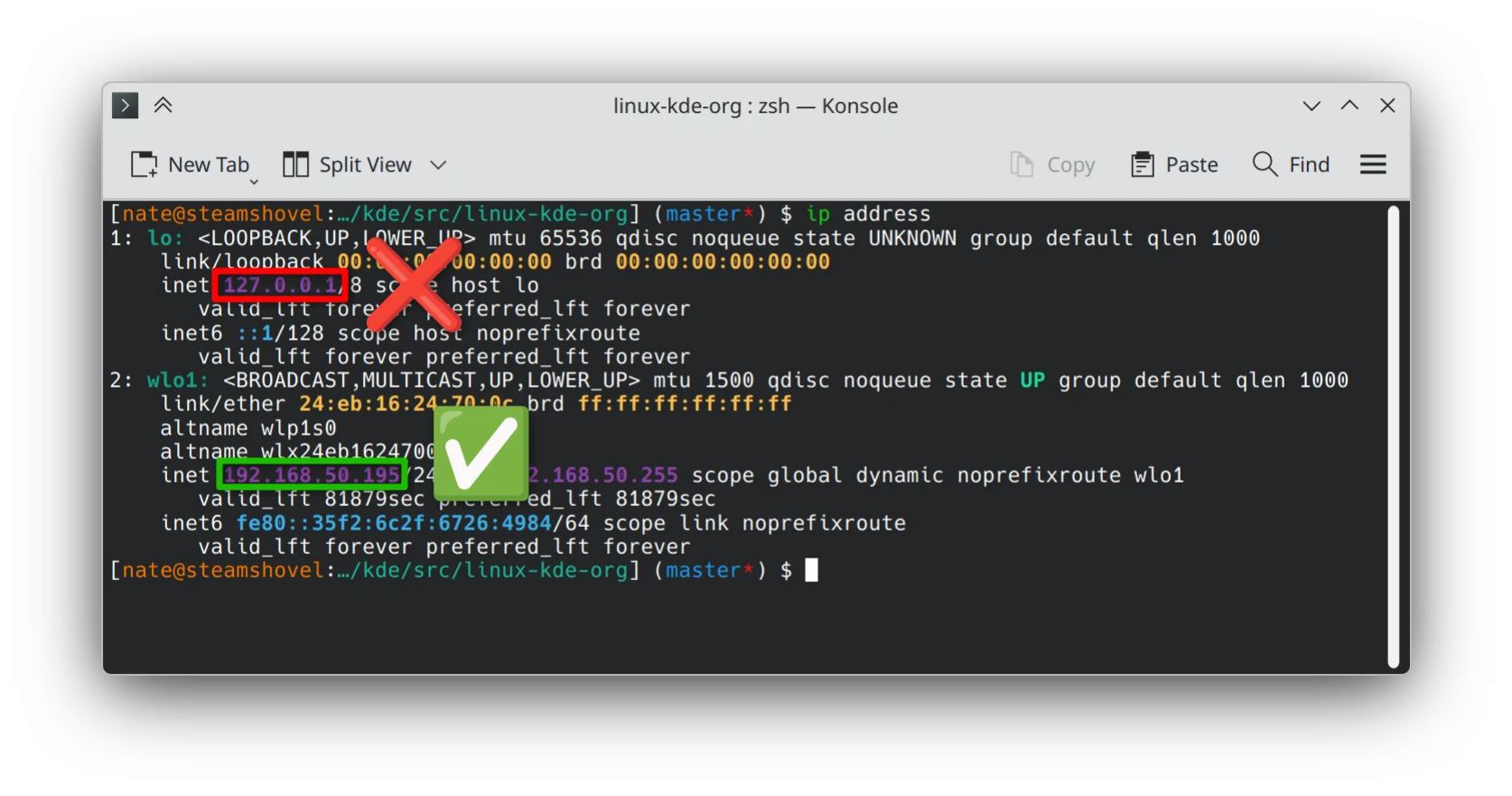
systemctl status sshd. If it worked, you'll see “Active: active (running)” mentioned somewhere. - Write down the system's IP address by running
ip address. Look under “inet” under the first entry that is not “lo”:
2. Connect via SSH on another system
- From another system on the same network, open a terminal app of your choice.
- Run
ssh [username of a user on the other system]@[IP address of the other system]. For example, to log in as the “alex” user on a system whose IP address is “192.168.1.1”, runssh alex@192.168.1.1. - When prompted, enter password of the user you specified.
Article contributed by Nate Graham under the CC-BY-4.0 license.